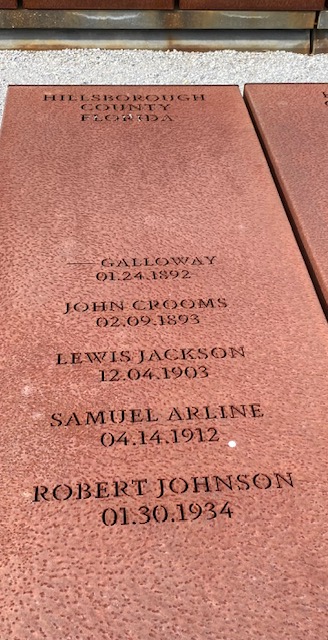
Hillsborough County
Jounrey to Sites of Memory and Public Remembrance in Tampa
Abigail Moncus
Walking Historic Landscapes
In her powerful and insightful essay, “The Site of Memory,” Toni Morrison wrote “On the basis of some information and a little bit of guesswork, you journey to a site to see what remains were left behind and to reconstruct the world that these remains imply” (Morrison 1995, 92). In this project on racial violence and public remembrance, we journey to three sites of history and memory in Hillsborough County. Created in 1834, Hillsborough is the fourth most populous county in Florida. Our study focuses on sites of memory in Tampa, the county seat and largest city in Hillsborough County, Florida.
This project explored historic sites across the city of Tampa that revealed hidden and silenced histories. While the sites are in different geographic locations of the city and represent different time periods, they are linked by racism and interlocking systems of social oppression. These stories are small but significant segments of a larger story of race, brutality, inhumanity and inequality across centuries of life in Tampa.
The methodologies used in this study include examination of archival documents such as written histories of historic places, newspaper articles, photos maps and public records. Archival documents and scholarly literature prepared us for the “walking methodology” we used to move through and across geographic and cultural landscapes in search of both revelations and concealment of the truth. The major focus of our walking methodology was Oaklawn Cemetery but in other parts of the city we also encountered murals documenting historic and contemporary legacies of police violence and recognitions of lynchings in Hillsborough County.
Oaklawn Cemetary and the Silences of History
The creation of Oaklawn Cemetery on April 1, 1850 predates Tampa’s formal incorporation as a city. At the founding of this cemetery (Tampa’s oldest), there were only 79 dwellings in Tampa and the town’s population was 441. All indications were that Tampa’s population would grow. Florida had been admitted to the union in 1845 as the 27th state, and rich white men from middle Florida were interested in Tampa. Hence, just as there was a need to accommodate new lives and new families, there was also a need to accommodate the inevitability of death in the small settlement. The cemetery was approved by the Hillsborough County Board of County Commissioners for “White and Slave, Rich and Poor”. This was primarily to control where people buried their dead.
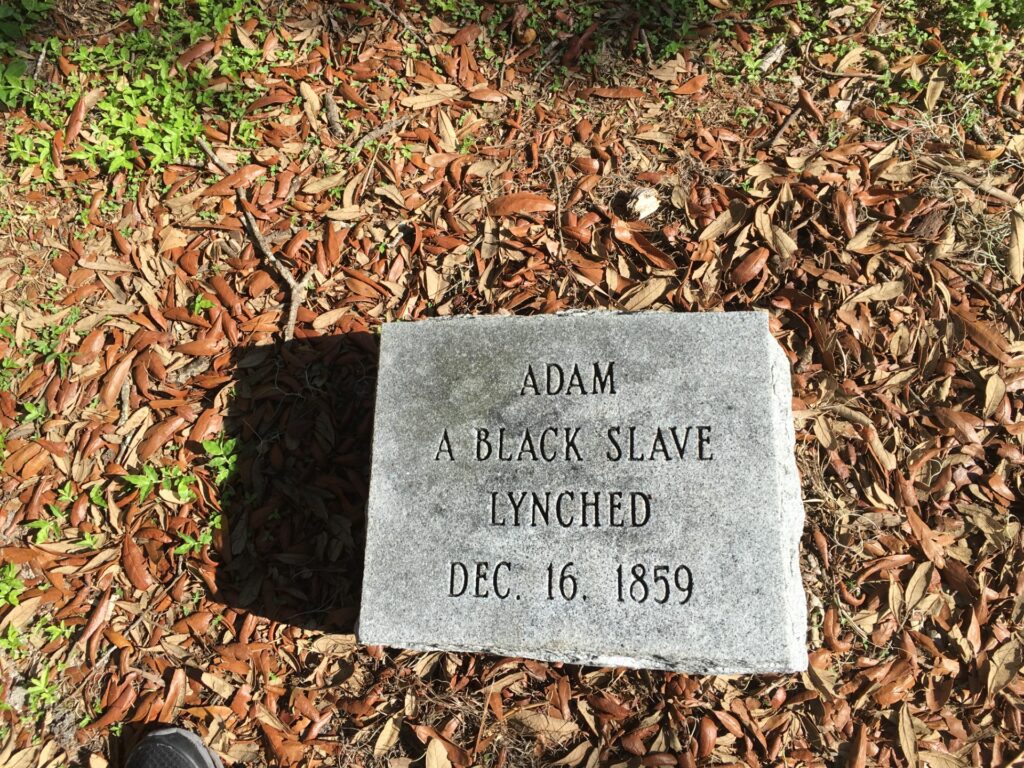
Yet, just as city leaders were concerned with managing the dead, they were also concerned about maintaining a social order that had long been established in the United States. As a result, cemetery plots were racially segregated in Oaklawn. Contemporary explorations of early cemeteries in many northern and southern states, reveal that racism pervaded burial practices, requiring either different graveyards for Blacks and whites or segregated spaces in interracial burial grounds. While there were a few exceptions to the spaces in which enslaved people were buried in cemeteries such as Oaklawn, the primary practice was to relegate all Black people to obscure corners of grave sites. Hence, in 1850 the Black dead were segregated in the northeast section of the “Old Burial Ground”. Their degradation as a scorned population persisted even in death.
Today, a walk through Oaklawn Cemetery is a history lesson in the glorious successes and achievements of those who contributed to life in the small village of Tampa from its early history and onward. Now designated as a national historical site, Oaklawn is one of the foundations of Tampa’s early history. There are many stories known and unknown in this hallowed site. Buried in the grounds and mausoleums of Oaklawn are men who were mayors of Tampa, a man who was a Florida governor, men who were Florida Supreme Court judges and several pioneer families whose legacies remain vibrant in 21st century Tampa. All of these men and women were White.
Walking further into Oaklawn, visitors can see that there are no marble, granite or concrete gravestones. In this section of the cemetery there are only small stones marking the graves of those held in bondage during Tampa’s early days. There are no epitaphs on the small grave markers of the enslaved dead who rest on the northeast portion of the original cemetery. Very little is known about these human beings who breathed air, walked the earth and also contributed to the life of early Tampa through their toil, care and sacrifice. Other than first names, there are no words anchoring these once living beings to a personal history or legacy. The small stones marking their graves only reveal that they were enslaved and they died. On some stones there are brief indications of violent deaths through drowning or lynching. But a sense of humanity and wholeness is not granted to most of those who were Black and buried there.
While there are few headstones in the racially segregated section of the cemetery, enslaved people were a part of the early settlement of Tampa at its founding in 1824. From 1830 to 1860 enslaved people made up nearly half of Florida’s population. Even though the population was smaller in Hillsborough County, by 1845, forty-four percent of the population was enslaved Black people. Newspapers of the time carried advertisements on the buying and selling of enslaved people. There are also many instances noted in court dockets and personal narratives of cruelty and brutality toward enslaved people. This includes recognitions of lynchings of enslaved people. An enslaved man named Adam had been found not guilty of murder but was still lynched by a white mob.
Oaklawn Cemetery is a major historical landscape because it is one of the very few sites that acknowledges the presence of enslaved people in Tampa’s history. In 2017 archaeologists used magnetic and radar detectors in the area of Oaklawn known as Section 4. They determined that there are more than 60 people buried in that part of the cemetery designated for Black residents.
The cemetery is a starting point for thinking about how race, brutality, slavery and the silences of history intersect in Tampa’s story.
Community Remembrance Project
On August 29, 2022, we attended a ceremony on the Tampa Riverwalk that acknowledged the lynching of Robert Johnson. This local event was organized in collaboration with the Equal Justice Initiative in Montgomery, Alabama. City leaders and residents from all walks
of life participated in developing the project. The marker is a permanent part of the Tampa Riverwalk, which primarily features biographies of honorable residents. In supporting the mural, City Council member Luis Viera stated, “A good community does not run from its history.”