Pinellas County
Lynchings and Sundown Towns
Laurie Humpel
Pinellas County is a peninsula on Florida’s central west coast, bounded on the west by the Gulf of Mexico, on the east and south by Tampa Bay, and on the north by Pasco County. Though only 280 square miles in total area — and just 274 square miles of land — it is the most densely populated county in Florida and the seventh most populous overall.
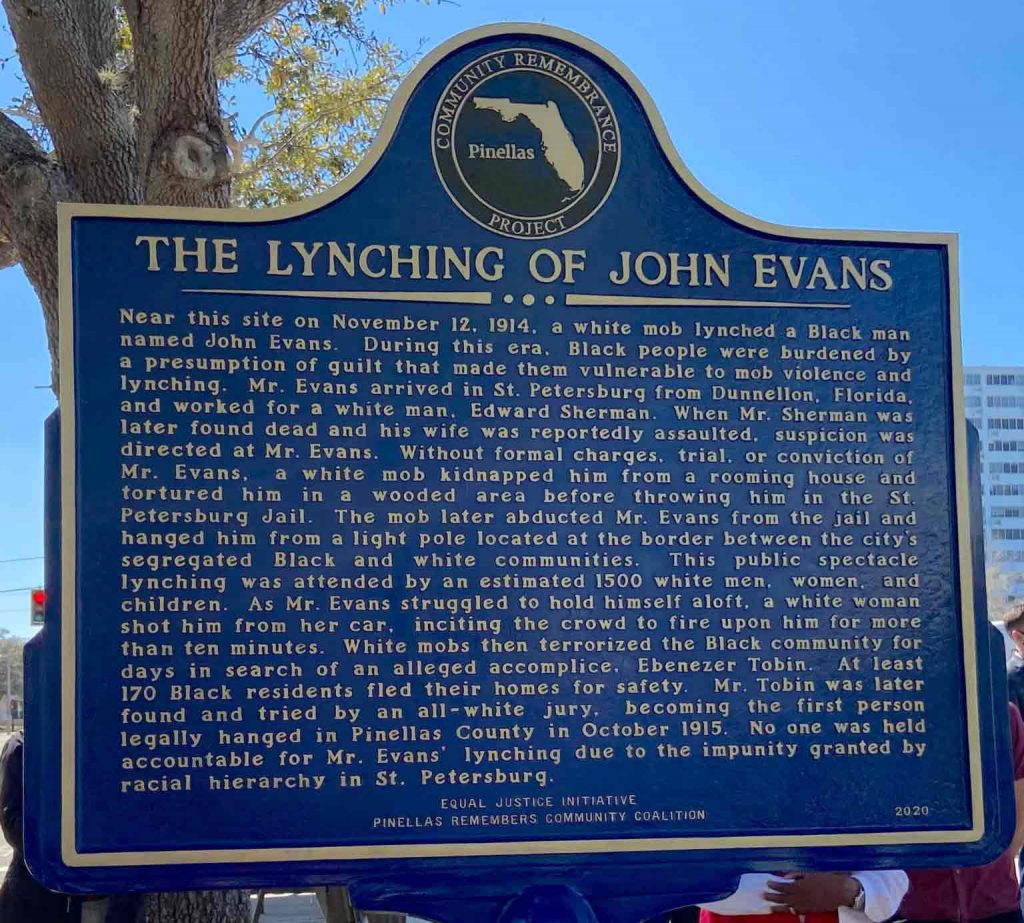
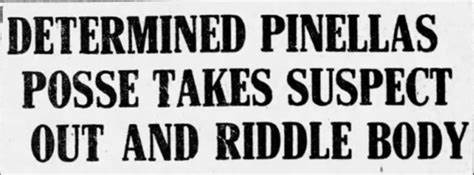
Using archival resources, informal interviews and observational walking, I conducted research on racial violence in various towns in Pinellas County, Florida. I also examined census data on African American residents at different times periods; I recorded descriptions of historic African American neighborhoods in the county, and I created a timeline of racial violence in the county. According to the Equal Justice Initiative, three lynchings occurred in Pinellas County, but only two have been fully documented: the lynching of John Evans in 1914 and the lynching of Parker Watson in 1926. The lynching of John Thomas in 1905 has not been fully documented, in fact, several questions remain, ranging from the lynching victim’s identity to whether the incident was indeed a lynching. This project also focuses on tracing evidence of “sundown towns” through newspaper archives and census data. It is interesting to note that there are public comments in local newspapers that communicated the mandate that Black people were not allowed to live in the southern Pinellas town of Gulfport. There were also policies like the 1934 ordinance created by commissioners in the town of Largo, threatening Black people with fines and arrests for being in the town after sundown.